AutoCAD DWG Export Options Dialog
The Export Options dialog allows you to specify options which determine how information in the file is exported.
|
|
|
Customize DWG export options in the Export Options dialog, DWG Options page. |
File Compatibility
Select the appropriate file compatibility. Available options are AutoCAD 2018, AutoCAD 2013, AutoCAD 2010, and AutoCAD 2007.
File Format
Choose Text (ASCII) or Binary to specify the format of the exported DWG file. See the AutoCAD DWG File Description for information on the organization of DWG files.
General Export Options
The following export options pertain to the objects within the DWG file.
All lines same color
Choose All lines same color if you don't want an AutoCAD color number (1-255) assigned to each of your lines. The default color for the layer will be used instead. All exported graphical entities are assigned to a layer named GSLAYER.
All lines same style
Choose All lines same style if you want exported lines to be assigned the default style (for the GSLAYER) when imported into AutoCAD. Otherwise, exported lines will retain their style (solid, dashed, etc.).
All lines same width
Choose All lines same width if you want exported lines to be assigned the default width (for the GSLAYER) when imported into AutoCAD. Otherwise, exported lines will be the width assigned in the application document.
All text as areas
If the (All text as areas) box is unchecked, text is exported as editable AutoCAD text entities, but all fonts are converted to AutoCAD's STANDARD font. Once the file is inside AutoCAD, the text entities can be edited in the normal AutoCAD fashion. Also note that while size and orientation are usually maintained, text will be converted to solid polygons if there's any shear (text slanted or not perpendicular to the text baseline), perspective (when the height of glyphs in the text string are not all the same or with text appearing in 3D), or clipping (text partially outside the map limits).
Checking the All Text as Areas box exports all text as DWG solid polygons, guaranteeing correct orientation. Whether or not these solid polygons (like all solid polygons) will be filled or not is controlled by the Fill solid areas option (see below).
Fill solid areas
Choose Fill solid areas if you want the interior of solid areas (polygons) to be filled. Otherwise, the areas will be exported as AutoCAD CLOSED POLYLINE entities.
Render marker symbols
Check the Render marker symbols check box if the marker symbols should be exported to the DWG file. The marker symbols are exported as lines and polygons. When the Render marker symbols option is not checked, marker symbols are exported to the DWG file as points.
Use ONLY spatial information
Choose Use ONLY spatial information if you want to export only spatial information and not object attributes or text labels. Spatial information is only concerned with the location of objects in space (i.e., their coordinates) and not with their attributes (such as line or fill style, marker symbol used, text labels, etc.) For example, if this option is chosen, all text will be ignored, markers will be exported as point entities instead of polygonal glyphs and coordinates output to the DWG file will be stored in map units instead of inches. This is useful when exporting base maps when only the spatial information is desired.
The AutoCAD program's behavior when importing DWG files (via the DWGIN command) is different depending on whether the AutoCAD drawing file [.DRW] is brand new or already contains drawing entities. If the file is brand new, attributes (such as line style) are loaded from the Tables section, so lines encountered in the Entities section will have the proper line style (solid, dash, dash-dot, etc.). However, if an old drawing file is already open, AutoCAD will ignore the Tables section and only read the Entities section. If the DWG file contains lines with styles not already defined, AutoCAD will issue an error message and abort the DWG import. It is recommended you choose the All lines same style option when exporting DWG files that will be imported into existing AutoCAD drawings. AutoCAD will then assign the default style to all lines in the imported layer (named GSLAYER).
Write LWPOLYLINE entities even when 3D data is availible
By default the Write LWPOLYLINE entities even when 3D data is available check box is not checked. Check the Write LWPOLYLINE entities even when 3D data is available check box to export all lines as 2D LWPOLYLINE entities. Z values will be written as ZLEVEL attributes when Write Z data is checked; no Z values will be written when Write Z data is cleared. Line properties will be saved.
Leave the Write LWPOLYLINE entities even when 3D data is available check box cleared to export 3D objects as 3D POLYLINE entities and 2D objects as LWPOLYLINE entities. The Write Z data check box is checked but not available to change, indicating that Z values will be written as attributes when available. 3D POLYLINE objects do not support line properties.
Use the File | Export command with the Write LWPOLYLINE entities even when 3D data is available export option cleared to export the contours as POLYLINE entities with the Z values written for each vertex. Use the File | Export command with the Write LWPOLYLINE entities even when 3D data is available export option checked to export the contours as LWPOLYLINE entities with the Z values as an attribute for each line.
Resize embedded images to less than [ ] (MB)
The Resize embedded images to less than option specifies the maximum size (in megabytes) an embedded image is allowed to be. If an exported image exceeds this size, its resolution will be reduced so it doesn’t exceed the designated maximum size. Increase this value to get better looking images at the expense of larger export files.
Defaults
The Defaults button sets all buttons and check boxes to default conditions.
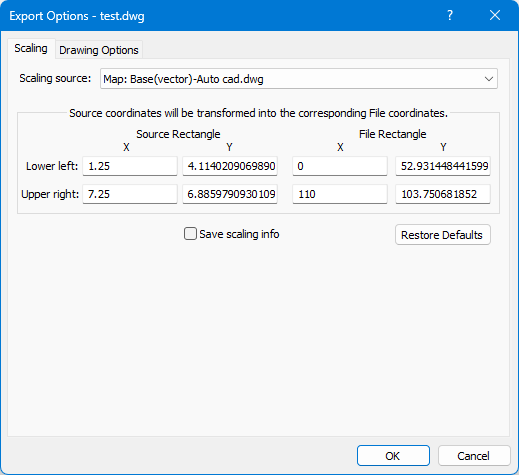
The Scaling Page
See the Scaling Page for detailed information.
See Also
AutoCAD DXF Import Automation Options
AutoCAD DXF Import Options Dialog